Tuesday, October 19, 2021

These industries are embracing remote work

How has Covid changed the way you are working?

We know more and more Aussies are working flexible hours and more are now working from home. Modern Man Working Remotely On A Computer From Hom

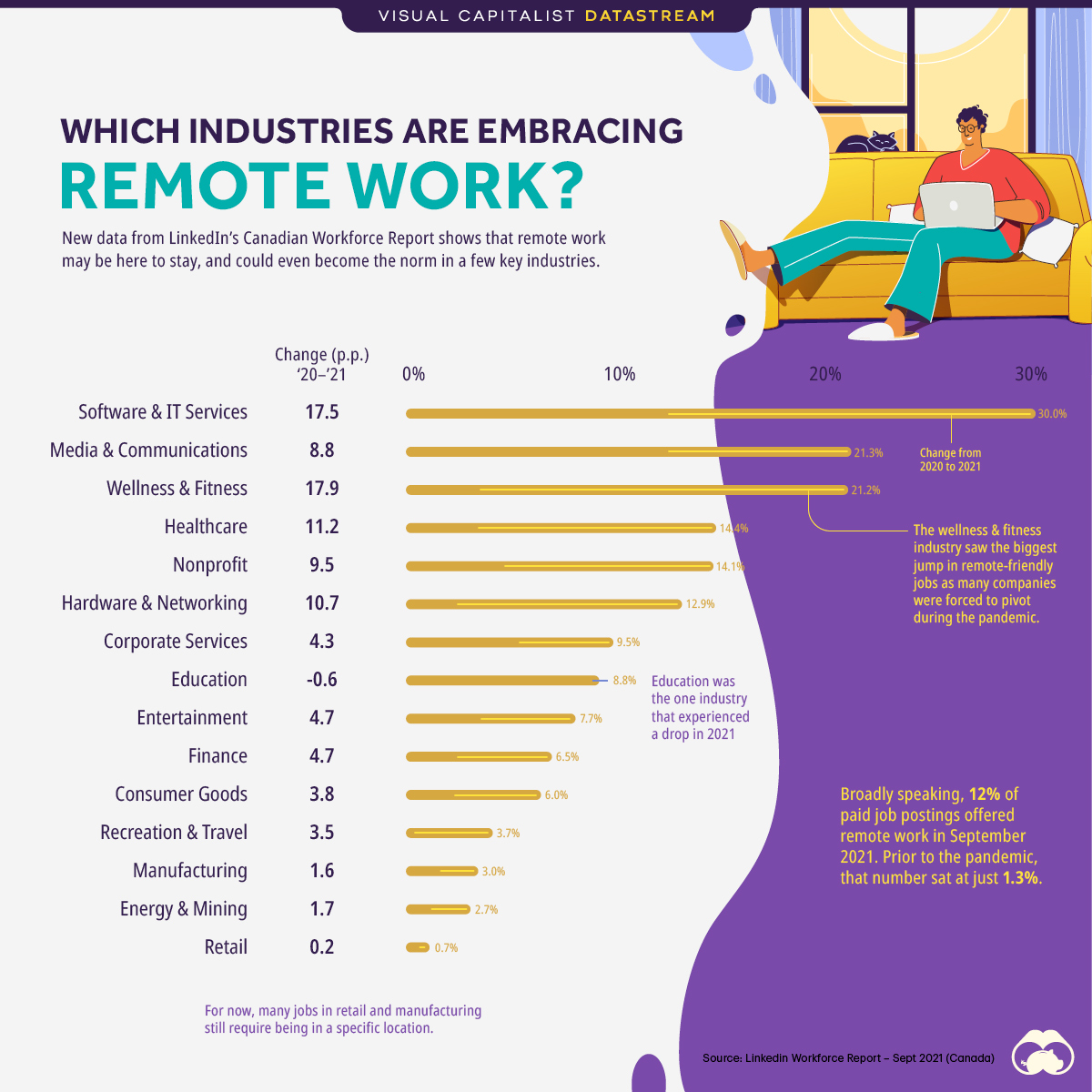
Recently LinkedIn’s Canadian Workforce Report confirmed that remote work may be here to stay, and could even be the norm in a few industries.

I’d be surprised if the situation was not similar here in Australia.

The report showed that four industries saw massive growth in the proportion of remote-friendly job postings.

Nearly one-third of new software and IT service jobs are listed as remote / work-from-home.

Which Industries Are Embracing Remote Work 1

Charting the Continued Rise of Remote Jobs

When the pandemic first took hold in 2020, and many workplaces around the world closed their doors, a grand experiment in work-from-home began.

Today, well over a year after the first lockdown measures were put in place, there are still lingering questions about whether remote work would now become a commonplace option, or whether things would generally return to the status quo in offices around the world.

New data from LinkedIn’s Workforce Report shows that remote work may be here to stay, and could even become the norm in a few key industries.

Broadly speaking, 12% of all Canadian paid job postings on LinkedIn offered remote work in September 2021.

Prior to the pandemic, that number sat at just 1.3%.

While this data was specific to Canada, the country’s similarity to the U.S. means that these trends are likely being seen across the border as well.

Which Industries are Embracing Remote Work?

The nature of work can vary broadly by job type—for example, mining is tough to do from one’s living room sofa—so remote jobs were not distributed equally across industries.

Here are the numbers on job postings that were geared towards remote work:

Industry % Remote (Sept 2020) % Remote (Sept 2021) Change (p.p.)
Software & IT Services 12.5% 30.0% 17.5
Media & Communications 12.5% 21.3% 8.8
Wellness & Fitness 3.3% 21.2% 17.9
Healthcare 3.2% 14.4% 11.2
Nonprofit 4.6% 14.1% 9.5
Hardware & Networking 2.2% 12.9% 10.7
Corporate Services 5.2% 9.5% 4.3
Education 9.4% 8.8% -0.6
Entertainment 3.0% 7.7% 4.7
Finance 1.8% 6.5% 4.7
Consumer Goods 2.2% 6.0% 3.8
Recreation & Travel 0.2% 3.7% 3.5
Manufacturing 1.4% 3.0% 1.6
Energy & Mining 1.0% 2.7% 1.7
Retail 0.5% 0.7% 0.2

Tech and healthcare industries are showing big shifts towards remote work, with the latter being influenced by a number of tech-driven changes, including telemedicine.

Physical distancing measures forced some industries to pivot quickly. Whether virtual fitness and wellness options (e.g. Peloton and Headspace) would remain popular beyond the pandemic was a big question mark, but this jobs data seems to indicate continued digital growth in these industries.

What the Future Holds

Since COVID-19 outbreaks are still underway, the true test for this trend will be whether these numbers hold up a year or two from now. When offices and gyms are reliably open again, will companies dial back the work-from-home options? Working From Home

Today, hybrid solutions are proving popular amidst worries that fully distributed teams suffer from lower levels of collaboration and communication between colleagues, and that innovation could be stifled by a lack of in-person collaboration.

Of course, employees themselves are reporting being more productive and happy at home, with 98% of people wanting the option to work remotely for the rest of their careers.

It’s clear that the culture of work is undergoing an evolution today, and companies and employees will continue to seek the perfect balance of productivity and happiness.

Source: This article was originally published at Visual Capitalist

ALSO READ: Australia is home to the world’s best city to work from home


from Property UpdateProperty Update https://propertyupdate.com.au/these-industries-are-embracing-remote-work/

Top 10 safest suburbs to live in Melbourne

Whether you’re looking to buy your next investment property, new home or even apply for a new rental, it’s important to suss out how safe the area is as part of your suburb research.

Is Melbourne a safe place to live?

According to the Economist Intelligence Unit’s (EIU) Safe Cities Index 2021 Melbourne is the 8th place (up from 10th place last year) safest city in the world.

Melbourne ranked 8th place for the world’s digital security, 4th for health security, joint 15th with Madrid for infrastructure security, 18th for personal security, and 25th for environmental security.

But the results aren’t that surprising, even amid the Covid-19 pandemic and continuous lockdowns and economic strife — after all, Melbourne also ranked highly among the world’s most liveable cities and also the best city in the world to work from home.

The top 5 Melbourne regions (% of suburbs that are lower than average risk) are the outer east (29%), north east (23%), north west (14%), south east (14%) and the west (7%).

But where are the safest suburbs in Melbourne specifically?

Here we’ve broken it down.

10 Melbourne suburbs with the lowest crime rates

Using the most recent Crime Statistics Agency data and Australian Bureau of Statistics (ABS) data, Canstar has been able to come up with a list of the 10 Melbourne suburbs where there were fewer than 2 criminal incidents per 100 residents between April 2018 and March 2019.

Criminal incidents mean any crimes against the person (such as assault and robbery), property and deception offences (such as property damage and theft), drug offences, and public order and security offences (such as disorderly conduct and public nuisance).

According to Canstar’s analysis, Melbourne’s The Patch had the lowest number of recorded criminal incidents by population for that period.

But to be fair – The Patch only has around  1,072 residents.

Interestingly, aside from Black Rock and Beaumaris, which are south of Melbourne’s CBD, all of the ‘safe suburbs’ identified by Canstar were in Melbourne’s east.

They are also relatively low-population suburbs when compared to more central areas.

Here are the top 10 safest suburbs in Melbourne:

1. The Patch (3792)

Incidents per 100 residents: 1.03

The Patch is a very small suburb of Melbourne, located 39km east of the CBD in the Shire of Yarra Ranges, and consists only of houses, a community hall, a general store, a primary school, several commercial nurseries and a tennis court.

According to Domain data, the suburb has a population of around 1,072 residents, mainly older couples and families giving an average age of 40-59, and around 90% of properties are owner-occupied.

2. Park Orchards (3114)

Incidents per 100 residents: 1.33 

Park Orchards is a green leafy suburb around 23km northeast of Melbourne’s CBD with around 3,829 residents, most of whom are families.

It’s a desirable suburb, not only for its low crime rate but also for the expansive parklands and schools.

And this shows in the property prices also – Park Orchards’ median house price is an impressive $1.8 million and consists of 97% owner-occupiers.

3. Ferny Creek (3786)

Incidents per 100 residents: 1.38

Located around 33km south-east of the CBD in the Shire of Yarra Ranges is Ferny Creek with a 1,506 population of mostly 40-59 year old couples and families and 92% owner-occupiers.

Known for its peaceful parks and recreation areas, the suburb has a reputation as a sanctuary away from regular day-to-day city life.

4. Selby (3159)

Incidents per 100 residents: 1.47

Another Melbourne suburb dominated by older couples are families, aged around 40-59, the small, safe and secure suburb of Selby is 37km east of the CBD also in the Shire of the Yarra Ranges.

Its small 1,643 population are mostly owner-occupiers (94%) of the local properties which have a median $825,000 price tag.

5. Kallista (3791)

Incidents per 100 residents: 1.53 

Kallista is another small Yarra Ranges suburb around 36km southeast of the CBD.

The suburb, along with others in close vicinity, is known for being leafy and secluded with a wealth of heritage and luxury houses and gardens.

Its $980,000 median price tag for property has attracted attention mainly from older couples and families looking for a retreat away from bustling city life.

6. Warrandyte (3113)

Incidents per 100 residents: 1.74

Warrandyte is a high demand property market with a $1.385 median price tag and a population mostly consisting of older couples and families.

Located 24 km north-east of Melbourne’s CBD the quiet and safe outer Melbourne suburb of Warrandyte is situated on the Yarra River and is enveloped by bushland.

It has a population of 5,502 and a median age of 43 years old.

7. Montmorency (3094)

Incidents per 100 residents: 1.74

Around 18km northeast of the CBD, Montmorency is well known for being one of the city’s best value suburbs which offers the perfect combination of lifestyle and affordability.

Montmorency topped the list of 100 suburbs across Victoria last year where the criteria for buying a home was ‘lifestyle under a million dollars’.

According to realestate.com.au, the median property price for houses in Montmorency is $962,000 for houses and $755,000 for units.

Based on five years of sales, Montmorency has seen a compound growth rate of 5.1% for houses and 4.9% for units.

8. Donvale (3111)

Incidents per 100 residents: 1.86 

Donvale is a suburb of Melbourne, Victoria, Australia, 20 km east of Melbourne’s CBD with a decent 12,347 population.

It’s a safe and quiet suburb with sought after tree-lined streets, very impressive sports and recreation facilities as well as excellent schools and access to public transport.

The median property price sits at $1,415,500 for houses and $775,000 for units, giving a compound growth rate of 5.5% and 4.6% respectively.

9. Sassafras (3787)

Incidents per 100 residents: 1.88

A little further out – 43km from the CBD – the picturesque village of Sassafras on the bushy and scenic Dandenong Ranges has a small 1,075 population of mostly 40-59 year olds.

The median property price is $807,500 but tight supply and a high-demand market mean there is little other data available.

10. Black Rock, Beaumaris (3193)

Incidents per 100 residents: 1.94 

Black Rock and Beaumaris, both in the city’s affluent Bayside area 18km south of the CBD, are famous for having some of the city’s best beaches, excellent schools and high-quality local facilities.

Unsurprisingly, property prices sit at the higher end of the scale.

Median house prices in the Black Rock and Beaumaris area are $1.83 million to $2.21 million, and around $1.07 million to $1.04 million for units.


from Property UpdateProperty Update https://propertyupdate.com.au/top-10-safest-suburbs-to-live-in-melbourne/

How much, on average, does it cost to build a house in 2021?

Build

In Australia today, how much can you expect to spend when building a house?

If you’re dreaming of building a new home, you may be wondering how recent events have impacted house construction prices including builder’s costs and stamp duty fees

Without sounding trite, the answer to this could be summed up with that frustrating yet often accurate phrase: how long is a piece of string?

There are a number of different factors that can impact the cost of building a house, including but not limited to:

  • the size of the dwelling
  • the location and availability of resources the slope of the land
  • the quality of the fixtures and fittings

With this in mind, there are some “ballpark figures” I can come up with, to give you a guide as to how much it may cost you to build a property.

But before I do, let’s look at…

1. How COVID-19 has impacted costs when building a house

While it’s hard to be clear exactly how much COVID-19 has impacted costs when building a house, it’s fair to say that with so many changes, border closures and restrictions it has changed the landscape.

Thanks to volatile exchange rates, supply chains being impacted and reduced productivity due to COVID-19 restrictions, costs have risen and the time to complete projects has dragged out pushing up the cost of construction.

The shortage of materials and labour are likely to significantly increase housing construction costs over the next couple of years.

Believe it or not, despite all the trees we have in Australia, prior to Covid 19 roughly 20% of Australia’s structural timber came from abroad, mostly from Europe.

Timber prices have risen 30 to 40% over the last few months and this is a phenomenal we are seeing around the world.

The boom in residential construction here during the COVID-19 pandemic had coincided with a surge in construction in major overseas markets like the U.S. and Canada, meaning overseas suppliers had been unable to meet this shortfall during the pandemic.

However the worst of Australia’s timber shortage has already passed, with a dive in overseas timber prices, better planning from builders and new support from the federal government likely to lead to reduced timeframes on residential projects according to a housing industry economist.

Angela Lillicrap, an economist at the Housing Industry Association (HIA), said that while it would take some time for the supply chain to fully correct, a fall in timber prices overseas would eventually be felt in the domestic market.

“It’s just going to be a matter of time until we’ve resolved this, so we’re definitely past the peak of it. It’s not going to get any worse, we’ve seen timber prices in the U.S. and Canada come off quite rapidly so it’s only a matter of time before that extra timber supply that comes from there comes over here [to Australia],” she said.

Recently the federal government committed $15 million to transport bushfire-affected timber from Kangaroo Island to mainland timber mills, heralded as a major step in solving the timber shortage.

Apparently this timber could be used to support the construction of up to 10,000 homes,although it will take years for all of the timber to be transported off the island.

2. What the recent government stimulus has done to building costs

HomeBuilder and other state-based programs have provided extensive support to the housing sector, particularly for detached housing as opposed to apartments.

With new contracts now no longer eligible for the HomeBuilder scheme, it is conceivable that the level of dwelling approvals will soften (possibly sharply) from here.

However, since June 2020, 114,000 private detached houses have been approved, the highest number of approvals over a 10 month period since 1989.

These record house building approvals driven by the government’s HomeBuilder program have sparked shortages of key tradespeople and helped push the price of materials up by as much as 50 per cent.

As the Australian Bureau of Statistics reported the number of approvals to construct new houses jumped 20 per cent to a record 13,939 in February, the Master Builders Association said building sites faced delays of up to three weeks to get tradies.

Home building is at six-year highs, but this building boom has created major challenges in the supply chains with builders meaning some projects can’t start on time, hitting customers with significant delays and pushing up the price of materials.

And disruptions to international supply chains are only making matters worse.

However, a range of other factors are also playing a role in increasing building costs including:

  • rising shipping costs for materials from overseas due to a shortage of empty containers because of Covid-19,
  • rising labour costs due to a shortage of skilled labour,
  • record low interest rates and a national housing shortage causing an unprecedented demand for new housing stock across the country.

Dwelling Approvals


Although HomeBuilder has now been phased out at the end of March 2021, it’s highly likely we will see a continuation in this trend towards higher residential construction costs as it will take some time for builders to work through the surging pipeline of house approvals.

Dwelling Approvals

Housing construction costs rose 0.8% over the March quarter

Building costs across all major Australian markets are growing faster than inflation – a trend that looks set to continue for years due to construction demand outstripping supply for both labour and materials.

Disruptions caused by COVID-19 are largely to blame with global supply chain issues negatively impacting both material delivery and pricing, while state and international border closures have led to intractable labour shortages.

The Cordell Housing Index Price (CHIP) which measures the rate of change of construction costs within the residential market and covers freestanding and semi-detached single and two storey dwellings rose by 0.8% over the three months to March 2021, making it the sixth consecutive quarter where costs have risen by 1.0% or less..

The first index for 2021 showed national residential construction costs rose 3.3% annually. Meanwhile, figures show the consumer price index (CPI) increased by 1.1% over the year to March 2021.

According to seasonally adjusted ABS figures, the total number of dwellings approved rose by 17.4% in March after February saw the total number of dwellings approved surge by 20.1%.

Employment in the construction industry, which accounts for around 8.9% of the total workforce, fell -1.5% over the three months to March 2021.

Tim Lawless, research director at CoreLogic, says “With dwelling approvals surging in response to the recently expired HomeBuilder grant, the residential construction sector is moving into what is likely to be an extended period of activity, however we are yet to see Cordell’s measure of construction costs reflect any material increase.

“Construction costs were up 0.8% over the March quarter, slightly below the decade average rate of growth and with little in the way of variation across the states.

“Although construction costs rose at a slightly slower than average pace last quarter, it’s likely future quarters will record a more substantial lift in construction costs as shortages of both materials and labour add some upwards pressure on prices,” says Mr Lawless.

The following chart shows the categories measured within the CHIP index.

Construction cost Trade breakup

Key findings – Q1 2021 CHIP Report

  • The New South Wales CHIP index remained flat quarter on quarter, with 0.7% growth in the first three months of the year, bringing annual growth slightly lower to 2.9%.
  • Victoria’s CHIP index grew 0.8% over the March quarter, slightly up on the 0.6% growth over the previous quarter. Annual growth was 3.4%, slightly higher than the national growth rate.
  • Queensland’s quarterly CHIP index growth dropped from 1.8% in the three months to December to 0.8% in the three months to March, bringing it back in line with the national growth rate.
  • South Australia’s CHIP index increased by 0.8% over the March quarter. Annual growth remained the lowest of all states at 2.8%.

construction costs

What’s ahead?

The 12th International Construction Market Survey from Turner & Townsend reveals that government money and low interest rates are fuelling a global construction boom.

Sydney remains the most expensive place to build in Australia.

The report predicts the Sydney, Perth and Brisbane markets will experience annual construction cost hikes of more than 3 per cent up to the end of 2023.

More modest yearly increases of 2.5 per cent are expected in Melbourne and Adelaide.

According to the report, the average cost to build in Sydney is $2640sq m and is interestingly less than half the rate of Tokyo, the most costly city in which to undertake construction at $5465sq m, followed by Hong Kong ($5317sq m) and San Francisco ($5080).

Melbourne building costs are $2576sq m, followed by Brisbane ($2448sq m), Perth ($2142sq m) and Adelaide ($2070sq m).

So how much can you expect to pay?

First up, let’s get one thing clear: the base price that builders advertise on billboards and display on their websites are generally only a starting point, and do not reflect how much your home will actually cost when it’s 100% completed.

This is because these “starting from” prices usually only include the basics.

If you are looking for a complete price that includes everything from the carpeting through to the landscaping and driveways as well as the white picket fence at the front, then you need to shop around for what’s known as a “turn-key” package – which means all you need to do at the end is turn the key and step inside.

The cost of building a house varies widely, particularly depending on where in Australia you are planning to build.

And as mentioned, the size of the property and the quality of the finishes will impact the final price, too.

According to ABS December 2019 Buildings Approvals data the Australian average was $1393.55 per sqm.

However, this figure doesn’t include design, planning permits, any site works or any cost blow-outs.

With the average dwelling in Australia being 229.8sqm, this puts the cost for the build portion alone at $320,238.

Look at the guideline below, according to BuildSearch.

1. Average costs to build a new project home

City Basic Finish $ P/Sqm Medium Finish $ P/Sqm Luxury Custom $ P/Sqm
Adelaide $900 $1030 $2750
Brisbane $1210 $1390 $3000
Melbourne $1180 $1330 $2900
Perth $950 $1010 $2600
Sydney $1190 $1290 $3100


Obviously one can’t really compare the cost of an architectural designed home to one built by volume builder for his little $1600 per square metre.

For a very high-end home with custom-designed finishes and tailored design, you can expect to pay much more – anything from $3,000 to $5,000 per square metre and up.

2. Calculating the average price to build a house in Australia

Everage House PriceIt’s all well and good to get a ‘per square metre’ indication of price – but how do you translate that into actual costs, to give you an understanding of how much you’re going to pay to construct your new home or investment property?

There’s no point in going to the bank and saying, “I need to borrow $1190 per square metre”; they’re going to need a little more info to go on than that!

To help you understand the full costs of building a house, we’ve run the numbers on a standard home build of around 150-170m2.

Based on this sizing, if you wish to build a three- or four-bedroom home with one or two bathrooms, prices typically start as follows:

  • A budget-style, basic home:

From $160,000 for a 3-bedroom home and from $190,000 for a 4-bedroom home. For a turnkey package, add approximately $18-20,000.

  • A standard home:

From $180,000 for a 3-bedroom home and from $200,000 for a 4-bedroom home. For a turnkey package, add approximately $20-22,000.

  • A premium, higher end home:

From $200,000 for a 3-bedroom home and from $220,000 for a 4-bedroom home. For a turnkey package, add approximately $22-25,000.

Adding an additional story can add around $80-100,000 to the cost of construction.

Learning the lingo:

When you go through the process of building a home, you’ll come across plenty of industry jargon that can be tricky to understand – and even trickier to price.

Here are a couple of terms that may be included in your building contract, which are important to understand:

3. Provisional Sums

A provisional sum is an estimated amount of money that is determined by the builder, according to how much they believe the relevant job or material will cost.

Build MoneyOften the builder can’t put a fixed cost on certain parts of the job at the time of providing a quote or signing the building contract because of unknowns.

For example, while your site may look flat and the builder quotes as such, when staring the works, they may discover large clumps of rock that need to be removed and levelled prior to the slab being laid.

Or when the builder starts digging your foundations they realise they have to dig down further to hit firm footings, which will eventually require more concrete to be poured.

At times like this you’ll need to pay an additional sum on top of the initial contract price, as the allowance that had been provided has been exceeded.

Note: It is always a good idea to budget for around 10% of the total build price to allow for fluctuations in provisional sum prices.

4. Prime Costs

A prime cost is an item that is subject to change during the construction of your home.

These include things like fixtures and fittings such as tiles, doors and taps, as these items may change depending on your final choice.

You’ll find an estimated amount is provided when signing the building contract, and then depending on your specification of the finishes during the build, these prime costs items may cost more or less if you elect to change them along the way.

Note: these items generally only change due to your change in preferences, so this could be an opportunity to trim costs if you opt for basic or standard fixtures, fittings and finishes.

What other costs can you expect to pay when building a house?

As mentioned earlier, there are a number of costs that come into play when building a house.

For a standard brick home without any custom finishes, you may be able to come up with a fairly clear budget.

However, once you start factoring in extras such as landscaping, driveways, retaining walls, fences and upgrades finishes and fittings, your costs can increase significantly.

These are some of the additional expenses to look out for may include:

1. Site Costs

Land CostThese are the expenses that are incurred to prepare your block of land before construction can even commence.

These are usually completed by your builder and in most cases, the site costs are charged on top of the build price.

Site costs for an average block of land can hover around the $15,000 to $25,000 mark, however again, the location, size and slope of the block of land can have a substantial impact on the final charges.

Some of the typical expenses involved in a site cost can be:

  • Connections to services such as water, sewer, electricity and gas
  • Fences
  • Retaining walls
  • Site clearance (trees, roots, bushes)
  • Site survey
  • Soil tests

2. Other factors that can impact price

Once you have signed a contract with a builder and decided up the layout and design of your property, they will make plans and prepare documents, before arranging a ‘pre start meeting’.

House CostsThe pre-start meeting is at the stage at which your house plans are finalised.

They are approved by council and you are ready to make your final choices in regards to all of the design aspects, such as wall colours, the types of light fittings and the materials used on the roof and on floors.

The ‘prime costs’ are generally already in place by the builder, however keep in mind that in base contract packages, the prices factored in often account for the cheapest materials, the most basic fittings and the most standard fixtures.

If you wish to change any of these, you could incur an extra cost.

Some of the parts of the home that you may wish to ‘upgrade’ during this process include:

  • Roof: depending on the materials you choose for your roof, such as tiles or colorbond, this can vary widely
  • Tiling: an allowance for a tiling amount per sqm will be made, but this can change depending on the quality and size of your final choice.
  • Fixtures and fittings: fancy, nonstandard taps and European appliances will obviously cost more than standard Australian-made fixtures and fittings. Additionally, labour costs may increase if you select items that are more complicated to install. Inclusions such as fully ducted air conditioning can cost up to $10,000 (more for two-storey home).
  • Kitchen: If you’ve ever shopped for a kitchen benchtop, you know how widely costs of a kitchen upgrade can vary. Again, the final price will depend on the quality of the item you choose and what is in your initial specification in the contract.
  • Electrical: If you decide to change your lighting layout from what has been initially drawn, this can add costs. For example, if the specifications in your contract allow for one standard light per room but you wish to have multiple downlights, this extra cost can add up.

3. Extra costs you should allow for

Some extra costs you need to take into account and which could end up costing you a significant amount of money include:

  • Soil Quality –One of the first things your engineers will organise is a soil test. They do this by drilling some bore holes and the best classification you can get is M classification soil. If your soil is more difficult to work with eg. Clay, Sand or Rock then you’re likely to have to pay extra.
  • Slope of the block– The easiest site to build on is a flat block. If your block slopes you’re likely to have to pay extra for more foundations, or to cut and fill the site (make it flat) and possibly for retaining walls.
  • Flood prone areas – some sites require the house to be raised with the floor level above natural ground level to cope with excessive rain or floods and this can add to the construction cost.

Contract variations

The final thing can impact your build price is variations, which are changes to the contract which are made after you have signed it.

Bulid HouseThe good news is, there is often an opportunity to change your mind as the build progresses if you really want to; perhaps you’ve been thinking about that glass splashback in the kitchen and decided it’s really not a good idea.

The bad news is, it will cost you!

Variation costs are costs you want to avoid where possible, as builders usually have a mark-up of about 20%-25% on variations.

On top of this, builders usually charge a variation fee of $250 each. These fees should be set out in your contract.

What’s the average time to construct a home in Australia?

There are too many variables associated with the time it takes to construct a house in Australia, making it virtually impossible to give an accurate time frame to build a house.

One off custom-built homes take longer to build the turnkey display homes which can often be build in 6 months.

And currently there are the ongoing construction delays associated with COVID-19, only adding to the time taken to build a house.

Then, there are the unforeseen hurdles that always seem to arise when building – things like unfavourable soil conditions such as rock removal, or bad weather or waiting for certain permits or approvals.

Having said all of that, the average time to build a two-storey house is roughly 10 -12 months.

In conclusion

While the cost of building to build home has clearly increased, the price of purchasing an established home in Australia has skyrocketed, with the value of many homes increasing by more than 20% this year alone.

The average cost of building a house varies due to a range of factors, including size, location and quality of fixtures and fittings.

While I’ve tried to give you estimates the final price will depend on whether you chose a display home which the builder has designed with cost efficiency in mind, or a unique home- your own special castle which has never been built before.


Want to get started in Land Banking or Property Development?

Metropole Team

You can trust the team at Metropole to provide you with directionguidance and results.

If you’re interested in getting involved at the “wholesale” end of the property market, we’ll help you become a property developer.

While smart investors know that investing in property is a sure way to build wealth, most buy property at retail prices then wait for capital growth.

Metropole’s Property Developer Program offers you the opportunity to purchase property at wholesale prices and lock in immediate profits. We enable you to become what we call an “armchair developer” and get all the benefits of real estate development without getting your hands dirty.

We allow ordinary Australians to become property developers and take the hassle out of your investment by assisting you with all the development expertise you need. From concept to completion. Click here to learn more about we can help you.

Then please leave your details here and we’ll be in contact to discuss your options.


from Property UpdateProperty Update https://propertyupdate.com.au/how-much-on-average-does-it-cost-to-build-a-house/

Unintended consequences for borrowers

The Australian Prudential Regulation Authority (APRA), has made a simple, but significant change to the lending rules for banks and other authorised lenders. 

ApraThis could well lead to some unintended consequences.

From November, borrowers seeking housing finance will need to demonstrate that they are able to meet repayments when interest rates are assessed at least 3 per cent higher than the actual loan interest rate applied to their loan.

This assessed rate, also called the buffer, floor, or repayment serviceability rate, was reduced to 2.5 per cent above the standard variable rate when it became apparent that we were not going into a recession as a result of the pandemic.

The issue is that the provision of housing finance is a complicated process because it needs to balance the risks to lenders of providing huge amounts of money against the opportunities that housing finance provides to home buyers and investors.

The history of broad-brush interventions in such complex systems, no matter how well-intentioned, shows us that there will always be some unanticipated and even undesirable results.

We may be about to see some of these unexpected outcomes in the coming months.

Moving from lower to higher floor rates in just one year

Before the recent APRA change, the low floor rate was one of the main drivers of the housing boom, because it enabled more first home buyers to enter the market.

At the same time, the lower floor rate has given all property buyers, including upgraders and investors, access to higher amounts of housing finance.

The lower floor rate had the same effect as a cut in interest rates of about two percent, and in my blog, ‘The property market stripped bare‘ in March this year, I predicted that this could lead to an average rise in housing prices of 25 per cent above pre-pandemic levels.

The increase in the floor rate will now reduce the potential for housing prices to rise nationally by 20 per cent over pre-pandemic levels, which is where the market was poised as at the end of September.

This slowing down of buyer demand is the aim of APRA’s change to the floor rate.

But what of the unintended consequences?

Existing homeowners will find it harder to refinance or move

APRA’s change will tie many existing homeowners to their current mortgages because their future loan repayment serviceability will be assessed at the new, higher floor rate.

They will find it more difficult to “shop around” for a better deal, use their equity for renovations, or even relocate in the future.

First home buyer demand will move, rather than reduce

Affordable HouseMany potential first home buyers will simply shift their search for areas where housing prices are more affordable.

While this will reduce demand in the most expensive first home buyer locations, it will also drive up demand in lower-priced suburbs and more or less costly types of housing until the new floor rate borrowing limits are reached.

So, rather than reducing overall home buyer demand, the rise in the floor rate will merely push first home buyers into more affordable locations and types of properties,  while tying many existing homeowners to their current mortgages.

ALSO READ: This is a chance to make a difference to home loan borrowers


from Property UpdateProperty Update https://propertyupdate.com.au/unintended-consequences-for-borrowers/

What to look for when buying an established apartment

Do apartments still make good investments?

During the last property cycle new and off the plan apartments were popular with many investors.

However, I’ve always maintained that most new and virtually all off-the-plan units are not “investment grade” properties.

Buy ApartmentThat’s because of their cookie-cutter designs, lack of scarcity, poor owner-occupier appeal, and propensity to create oversupply problems, which is exactly what many capital cities have experienced over the last few years.

In fact, many owners of new units have seen their property values drop as well as rents go backward, which have created serious cash flow problems for some.

On the other hand established “family-friendly” units can make great investments, especially older ones, because if they are well located and have a functional floor plan.

Ditto, more of us are trading backyards for balconies and courtyards and want to live in medium-density dwellings.

However, like anything that is getting a bit long in the tooth, some are in need of a facelift or upgrades to improve issues such as wiring and ancient lifts that can prove costly for owners.

So, before you rush out and buy an apartment that might be older than you are, here are some things that you should look out for.

Art deco apartments

Art deco apartments continue to be very sought-after in our capital cities because of their aesthetic appeal, architectural details, and ornate plasterwork.

Built in the 1920s and 30s, they are also known for being functional, well-built, and close to city centres.

The thing is, many of them are nearly 100 years old now and are starting to show their age compared to modern designs and utilities.

Some art deco apartments can suffer from concrete cancer as well as a lack of power and data infrastructure for our modern-day needs.

Art deco apartments can also have poorly maintained utilities, such as wiring and plumbing, which are expensive and painful to remedy.

Before investing in an art deco apartment, you must:

  • Always check its maintenance history.
  • Invest in a comprehensive building inspection.
  • Assess whether there is any major maintenance mentioned in the owner corporation records, which might require a special levy in the near future.

1950s and 1960s apartments

1950s And 1960s ApartmentsWhile the 1920s and 30s were about art deco’s unique style, the following decades were more about form and function.

This means that apartments built in the 1950s and 60s are, well, a bit dull!

While they may be located within small- to medium-density complexes, they generally have no real facilities or balconies.

Apartments from the 1960s suffer from the same lack of imagination, coupled with no air conditioning or lifts.

However, these units can be upgraded internally easily enough as they generally have bigger floor plans than their art deco cousins.

If you’re considering investing in an apartment from this era, you must:

  • Review the maintenance history to see what work has been done in the building.
  • Look for utility maintenance records to ensure they are up to date.
  • Check the sinking fund as well as signs of any past or upcoming special levies.

1970s and 1980s apartments and beyond

It wasn’t until the 1970s that the design of units started to become more appealing.

1970s And 1980s Apartments And BeyondBy that stage, our population had grown significantly, including waves of overseas migrants who were used to living in apartments, so we’re seeking those dwellings as their first choice, rather than their second.

So, units suddenly became much larger with better layouts as well as lifts and balconies.

It seems architects finally started designing units that suited Australia’s unique climate.

Rather than copying the way things were in the United Kingdom, which, let’s face it, doesn’t get a lot of sun!

By the 1980s and 1990s, unit designs incorporated more bedrooms and bathrooms as more and more people chose balconies over backyards.

Before investing in a unit from this era, you must:

  • Check to see if lifts have been replaced since original construction.
  • Double-check that utilities have been upgraded to modern standards.
  • Check for any magnesite-related defects or cladding issues.

Apartments built in the last 10-15 years

Many of the high-rise towers built in the last fifteen years will underperform with poor, if any, capital growth in the foreseeable future.

Of course, these Lego Land apartment blocks never made good investments.

Apartment RandwickThey offered little scarcity and had no owner-occupier appeal having been built with investors in mind, and often overseas investors who didn’t fully understand the needs of the local market.
Worse still… because of the high developer margins and marketing costs, many investors paid too much to start with and have since found that on completion their properties were worth considerably less than their contract price.

The sad reality for these investors is that today, in light of the many media reports of structural problems in some of these high rise towers, there is a crisis of confidence with apartment owners concerned about what unknown issues and liabilities may lie ahead for them and potential purchasers are holding back not wanting to buy themselves futures problems.

This sector of the property market has lost the trust of the buying public and confidence will take quite some time to restore as various stakeholders including state and local governments as well as the construction industry including building surveyors and certifiers scramble to shore up building sector.

These issues will lead to a flight to quality, meaning well constructed, medium density apartments and townhouses will continue to be strongly sought after and will keep increasing in value, making them great investments, while some of the towers built over the last decade will become the slums of the future.

At the same time, in this new Covid environment, fewer people will want to live in large apartment blocks where they share common facilities.

The bottom line

House Or ApartmentDemand for apartments is set to accelerate from a more diverse buyer profile as apartment living emerges as a preferred lifestyle for many, from the younger generation leaving home to the older generation wanting to downsize


But be careful if you’re planning to buy an apartment.

Many of the buildings built during the last construction boom will have a shadow hanging over them for some time.

At the same time reluctance from future purchasers will make it harder for new developments to have sufficient pre-sales to get out of the ground at a time when tighter planning restrictions for apartments, particularly in suburban areas, will exacerbate the emerging undersupply of dwellings required by our growing population.

This will create two tiers of units moving forward.

Solidly built established “family-friendly” medium-density apartments and townhouses developed by reputable builders and on the other hand, the many of the towers that dot our big cities could well become the slums of the future.

ALSO READ: Housing affordability pressures create pain for apartment upgraders


from Property UpdateProperty Update https://propertyupdate.com.au/what-to-look-for-when-buying-an-established-apartment/

When will we reach peak humanity?

When will we reach peak humanity? Peak Humanity

When will the largest number of people ever walk on planet Earth.

And what does it actually mean for Australia?

Firstly, the simple question is where do we get that population projection from?

The most famous big picture global population projection figures come from the United Nations population division.

They project that we will reach peak humanity at 11 billion people up from close to 8 billion people today around the year 2100.

These projections are the most famous middle scenario of their various scenarios.

Increasingly the other big demography centres across the world tend to disagree with that view, because we see that the nations of Africa, in particular, become richer and more educated at a faster rate than we previously expected, which drives down the fertility rate, and therefore those countries don’t grow as fast as we expected.

So, therefore, Wittgenstein centre in Vienna, for example, expects peak humanity at under 10 billion people by 2070s — only 50 years from now.

We also have a couple of other projections that suspect peak humanity at around 9.4 billion people at some point in the 2060s.

So if you are under 40 today according to the latest projections there is a chance that you will see peak humanity, and that you will actually live at the declining, shrinking planet from a human population perspective.

For example,  if the overall planet starts to grow older we will then see a global fight or a competition for young talent because we need to make sure that the countries of this planet are young enough to afford to finance the retirement of the ever-growing share of the old folks.

That’s difficult to achieve and we can look at famous examples such as Japan.

Japan managed to grow rich before they grew old, so that means that they now have enough money flowing around.

The Japanese also completely changed the social contract, which means they allow women to re-enter the workforce even after they got married, which wasn’t the case for a long time.

And, of course, they doubled down on high-tech automation to make sure they can run an effective lucrative economy with an ever-shrinking pool of workers.

These are the trends that you will want to do as a country on a globally shrinking planet:

  • you want to make sure to get the brightest young talent to make sure that you still have a sizeable chunk of workers that can provide enough economic output to finance the old, and Jp Robotics
  • you want to make sure that your economy transitions into a smart economy, into a knowledge economy – a high-tech economy that heavily relies on robotics.
  • And I would also argue that the Superannuation scheme as we run in Australia is actually really helpful in a shrinking planet because you want to make sure that every worker finances their own retirement which isn’t the case in countries like Germany at the moment where they essentially have one big retirement pocket and you just hope that when you are old you will get enough money back. In theory, these funds could be redistributed in different ways. The Superannuation scheme we have in Australia really guarantees that you get your fair share of Super. Of course this only works out for those workers who earn enough money to put enough aside.

So there will be a growing share of poor people in Australia whose retirement does need to be financed through a pension scheme.

Therefore, we must not think that Superannuation will solve all of our problems just yet.


from Property UpdateProperty Update https://propertyupdate.com.au/when-will-we-reach-peak-humanity/

Monday, October 18, 2021

Five tips to make you a better negotiator

One of the skills of being a good negotiator is knowing when not to talk but to listen.

I have found that many inexperienced negotiators are too eager to show off just what they know.deal property busing

This can work against them as they often reveal too much too soon, in particular about what they are willing to give up to get the deal.

Of course, this is just as important whether you are a property investor negotiating a multi-million dollar deal, or whether you are an employee negotiating with your boss.

A good negotiator recognizes that they must let go of their ego satisfying position of “know it all” and instead assume the profit-making position of innocence.

They realise that you can gain a lot from being silent and listening and at times using facial expressions, not your voice, to make a point.

Here are five tips on how perfecting the art of silence can make you a better negotiator:

1. Listen more

Listening is not passive.

You can control the negotiation process by simply listening well.

When you listen well, you can gain the trust and confidence of others and build rapport.

This makes the next stages of negotiation easier as people like dealing with people they fell comfortable with.

When people are encouraged to talk, they tell us their needs, their wants, their desires. 

In short, they give us information.

When we truly listen to people, we make them feel important, particularly if we are making good eye contact while listening.

The problem is that most of us don’t truly listen when others talk.

We just can’t remain silent long enough to really hear them.

Chances are we are just marking time until we can jump in and start talking again.

As a negotiator you should be aware that every time you talk, you are potentially open yourself up to being vulnerable.

2. The 10 seconds of silence strategy

Silence makes most of us feel uncomfortable.

In today’s world we are conditioned to noise, not being silent.

Next time you are negotiating try this little trick….

When the other party says something like “well, that’s my offer” don’t say a word for ten seconds.

To inexperienced negotiators, ten seconds will seem like an eternity.

It’s practically guaranteed they will jump in with another offer or more information, anything to break the silence.

3. Ask more questions

One of the secret weapons of good negotiators is to ask questions – and then remain silent.

The person asking the questions controls the conversation. Housing Market Question Mark Symbol

And you’re not always asking just to find out information, because if you have done your homework before commencing the negotiation, you should already know the answers.

You’ve probably read that lawyers are taught to never ask a question without already knowing the answer.

That’s also good advice for negotiators.

What you are really doing is getting the other person to talk, perhaps to verify your information, but really to feel more comfortable working with you, and to build rapport.

O.K. let’s put the shoe on the other foot – when you are asked a question as part of a negotiation, there is no rule that says you have to answer.

Try remaining silent.

What usually happens is that the questioner will start talking again.

Another trick is to throw the question back by saying something like “before I answer that, please tell me why you asked that question.”

4. Pause between sentences

A good trick is to learn to pause for a second or two between sentences – especially if you are a fast talker.

It helps the other party take in what you’ve just said and analyze it.

Just like a good comedian understands the importance of timing and pauses, a good negotiator understands the art of pausing between sentences for more emphasis.

5. The flinch, the shrug, the smile

It is well recognised that a large part of communication is nonverbal.

Often what you do is more important than what you say.

Let’s look at three actions that carry a powerful message, as you remain totally silent!

Why not try the flinch.

This is a quick, jerky movement of your shoulders while you have a suffering pained look on your face.

It will send the message that you didn’t like what you just heard. 

Then remain silent and wait for the other party to speak. Meeting outside

And they usually will, trying to break the silence and hopefully sweetening the deal.

Or you could try the shrug.

Shrugging your shoulders sends the message that you just don’t care.

You’re not interested.

Then, once again remain silent.

And of course, there is the smile.

A silent smile is enigmatic leaving the other party trying to guess what you are thinking.

And of course, don’t be the first person who speaks.

Learn to listen

Nature gave us two eyes, two ears but only one mouth.

During negotiations use them in the right proportions.

Power negotiators know that what you don’t say is sometimes more powerful than what you do say.

ALSO READ: The 7 Rules of Power Negotiation


from Property UpdateProperty Update https://propertyupdate.com.au/five-tips-to-make-you-a-better-negotiator/